On page 37 of
I'm Stalking Jake!, in the middle of a chapter
called "The Saga of Stephen, Father of Jake," there is a footnote
alerting readers to the fact that there's an alternate version of the
story they're reading:
A Poet from Hollywood, by Cantara
Christopher. I offered no commentary on Cantara's take because at the
time of publication, I didn't know what Cantara's take was. None of us
did, actually, until a couple of weeks ago, when Cantara herself started
to circulate an
advance PDF copy of A Poet from Hollywood, having at long last finished it.
If you've read I'm Stalking Jake!,
you undoubtedly already have an opinion of Cantara herself. She is a
character if ever there was one, and my relationship with her has had so
many ups and downs in the last six years that I've lost count. As I finished reading A Poet from Hollywood last week, I wondered how best to comment on it. At first I thought perhaps a short review here. Then I thought maybe just a private e-mail to Cantara. I compromised with what's below:
Cantara,
As someone who knows full well the cathartic release of writing a book to work through the complex aftermath of expending emotional energy on a male member of the Gyllenhaal family, I hope that you feel the relief that I did once my story was written down and out in the world.
It was somewhat surreal for me to read your book. It was a little less than six years ago that I walked into a poetry bar in New York City and learned one of the biggest lessons of my burgeoning adulthood: that fame is hollow, and so is the act of admiring it.
 |
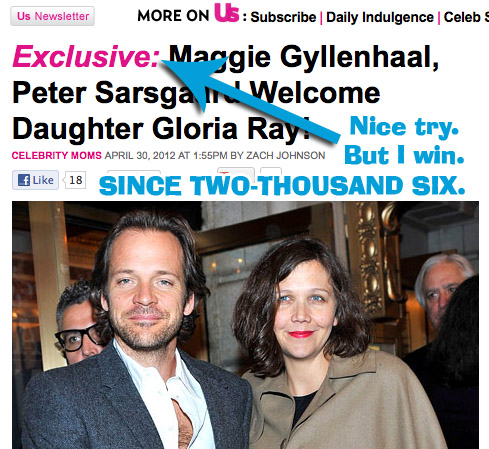
| Optimistic art from my pre-Babygate self. |
I remember that night a little differently than you do (my meticulously detailed account of that weekend in New York and its immediate consequences takes up three lengthy chapters in my own book) and I don’t recall the conversation with me that you recount from months after… I was so angry about it all. Angry at Stephen. Angry at you. Angry at myself for giving the two of you enough power over me to invoke anger in the first place…
But where we don’t differ in our accounts is in the honest acknowledgment that emotions were running very high in October of 2006. You were at that reading for one Gyllenhaal and I was there for another. That Jake was supposedly outside the poetry bar, waiting with his mother, was a detail you offered casually, but it amounted to probably the biggest shock of the entire book for me. If true, what a tragic miss for my 24-year-old self. Maybe more tragic, even, than my miss the following night. I have never felt more invisible than I did on a cold sidewalk in New York City, bundled in a ratty coat and ripped jeans, while a movie star in a tuxedo turned his back to me and kept walking as I yelled his name.
No, wait. I take that back. There
was a time when I felt more invisible. Ten minutes later, when the movie star’s father, who had dressed me down at length at his poetry reading less than 24 hours earlier, caught my eye and looked away again without the slightest hint of recognition. Nothing.
For the longest time, I took that as a reflection on me, an indication of my memorable-ness and worth. It’s hard to believe, thinking back on it, that there was ever a time in my life when I would have cared that much what he thought, or (and I say this without any hostility) what you thought. I truly believed you guys had it figured out – you, the Gyllenhaals – and if I could just prove to you that I was worthy, you’d let me into your club, and I could have it figured out too…
Yes, the 24-year-old me would have fallen all over herself had she seen Jake Gyllenhaal standing with his mom in the shadows outside that poetry bar…
 |
| A couple of troublemakers. |
By my own recollection, Stephen listed Jake’s whereabouts as Martha’s Vineyard that night. Although with the portrait you paint, it’s difficult to know whether or not Stephen ever really knew what the hell he was talking about, so I guess that one will remain a mystery. What isn’t a mystery is the inaccuracy of my initial perception of all of you, the misguided outcome of youthful naiveté. Of course you didn’t have it all figured out. No one has it all figured out. And I applaud you for so openly laying out the faults of the characters in your book.
There were parts of the book that made me sad, because they reminded me of the lost potential of that era. They reminded me that as late as 2008, I cared enough to slog through all 332 pages of the grim, disturbing mess that is Stephen's unpublished novel,
Liquid Motel. And they reminded me that it wasn’t until March of this year (less than six months ago!) that I posted a final entry on
I’m Stalking Jake!, the blog I wrote in the spirit of Jake Watch to promote the book of the same name. Writing that blog almost broke me. Putting on my “Prophecy Girl” costume and trotting out cutesy one-liners required putting aside all the hard-won peace I’d gotten from writing my book. While I waited for it to be published, I had to pretend. Pretend to value fame. Pretend I still cared about Jake. Pretend I wasn’t bitter that after all I’d accomplished with my writing, I was reduced to selling myself in order to sell a few books, because despite all the traveling to New York for poetry readings, instead of connections, I’d walked away from Jake Watch with nothing but dead ends.
But here I am now. And it’s been a long, slow, but oh-so-rewarding process to move past all of it. None of it has any power over me anymore. Everything that I wanted to say about that era of my life has been written down and released into the world. Both literally and figuratively, the end of my book - and its blog - meant I could let it go.
Stephen infamously once told me that “it’s all about learning,” and over the years, I’ve hijacked that phrase for my own personal use; I like the sentiment behind it. I don’t know what he learned, if anything, from the many failed creative ventures you detail in your book. I think what
I learned while reading was just how distant my past has become.
And as for you, Cantara, I hope that you now feel the unique freedom that comes from having told your story the way you want it told – having given it life outside of yourself. We don't remember it the same way, in some cases not at all, but a common theme in our two stories is the two men with the same last name who never quite managed to live up to our expectations. Wrapped up as they were in their own lives, they failed to see the bigger picture.
Their loss…
Becky